Circulation
We are made up of trillions of cells and as such, most of them are a long way away from a direct source of food and oxygen. Unicellular organisms such as bacteria and yeast do not require a circulatory system since direct diffusion is sufficient to provide them with what they need to survive. However, for multicellular organisms like humans which have a small surface area to volume ratio, a transport system is essential. Just think about how far from your small intestines your fingers are, or how far your toes are from your lungs. The circulatory system transfers substances to and from the body cells.
This site is a really good resource for information about the circulatory system:
This site is a really good resource for information about the circulatory system:
|
Components of the circulatory system
There are 3 components:
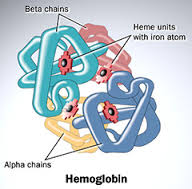
This is a simplified representation of haemoglobin, the protein within red blood cells that allows them to carry oxygen.
Haemoglobin is an example of a quaternary protein - that is, it is a protein that is actually formed by 4 separate chains of amino acids folding together. Each molecular of haemoglobin contains 4 iron atoms, and it is the iron that allows the carriage of oxygen. When haemoglobin is bound to oxygen (oxyhaemoglobin), it has a red colour, but in its deoxygenated form it is blue-red. One red blood cell contains about 250 million molecules of haemoglobin which allow it to carry 1000 million molecules of oxygen at any one time. Clever huh?! |
BLOOD... There are 4 components of the blood, each of which has important roles.
|
ABO Blood Groups
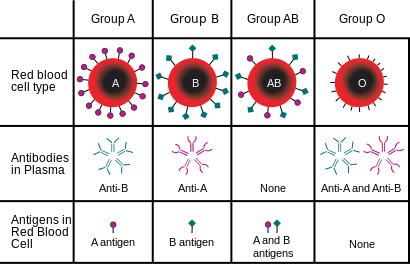
In 1900 an Austrian scientist called Karl Landsteiner identified the ABO blood grouping system. Prior to this point, it was very hit-and-miss as to whether you would survive a blood transfusion. The central principal of the blood groups is that antigens are present on the red blood cells, and it is what compliment of antigens you have (or don't have) that determines your blood group.
In addition, there are 2 types of antibodies:
You will NOT have the antibodies against the antigens that you express on your red blood cells (so, if you are blood group A, you express antigen A on your red blood cells, and thus have anti-B antibodies in your plasma).
In 1900 an Austrian scientist called Karl Landsteiner identified the ABO blood grouping system. Prior to this point, it was very hit-and-miss as to whether you would survive a blood transfusion. The central principal of the blood groups is that antigens are present on the red blood cells, and it is what compliment of antigens you have (or don't have) that determines your blood group.
- There are 2 types of antigens: antigen A and antigen B
In addition, there are 2 types of antibodies:
- Anti-A and anti-B
You will NOT have the antibodies against the antigens that you express on your red blood cells (so, if you are blood group A, you express antigen A on your red blood cells, and thus have anti-B antibodies in your plasma).
|
Remember: If you have blood type O, you do not express any antigens on your red blood cells. If you have blood type AB, you express both antigen A and antigen B |
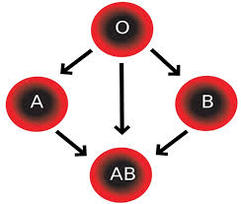
Knowing what blood group you are is critical in determining what blood can you receive during a transfusion. If you are given the wrong type of blood, the antibodies present in your plasma will bind to the antigens on the red blood cells in the donor blood, causing clumping, or agglutation. This can be lethal.
Here is a different way of looking at blood compatibility. DO NOT worry about learning or remembering this - you are better off learning the above table and knowing which antigens and antibodies each blood group has. This will allow you to work out compatibility.
Here is a different way of looking at blood compatibility. DO NOT worry about learning or remembering this - you are better off learning the above table and knowing which antigens and antibodies each blood group has. This will allow you to work out compatibility.
If you are still unsure, go to Blood.co.uk which is full of interesting information on blood
|
Blood clotting is a series of enzymatically-controlled reactions which result in the formation of a clot. Damage to a blood vessel (such as a cut) activates the platelets. Platelets cause fibrinogen (a soluble protein) to form a mesh of insoluble fibrin. This acts to trap red blood cells, forming a clot. When the clot dries it becomes a scab.
Inappropriate activation of platelets can cause an internal blood clot, called a thrombus, to form. These can be deadly as they can move around the body, potentially blocking blood vessels in the brain or heart. |
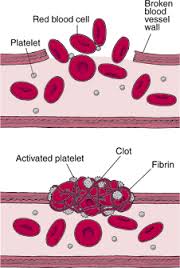
|
Anatomy of the heart
|
Arteries
Capillaries
|
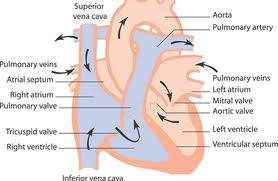
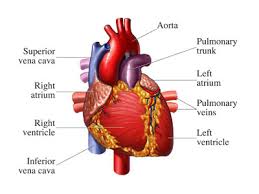
The blood vessels that you need to remember are:
The human circulatory system is a DOUBLE CIRCULATORY SYSTEM. This means that for every circuit of the body, the blood passes twice through the heart. Pulmonary circulation - from heart to lungs and back again Systemic circulation - from heart to body and back again |
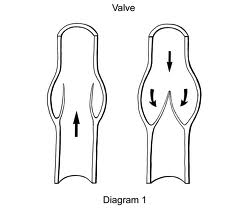
|
If you are still unsure about the circulation of blood, have a look at this You Tube video called Pump It Up! Thanks Tolia! |
|
Research Project
For your research project, I have asked you to look into how the circulatory system can go wrong, and what medical interventions there are available to treat diseases and conditions of the heart and blood vessels. Here are a few links to sites to get you started that will help you find the information you are looking for. Remember: this needs to be in your own words. DO NOT copy directly from any source, be it the internet, your text books or a journal article. That is plagiarism and as you know, this will not be tolerated.
For your research project, I have asked you to look into how the circulatory system can go wrong, and what medical interventions there are available to treat diseases and conditions of the heart and blood vessels. Here are a few links to sites to get you started that will help you find the information you are looking for. Remember: this needs to be in your own words. DO NOT copy directly from any source, be it the internet, your text books or a journal article. That is plagiarism and as you know, this will not be tolerated.
Check out this excellent website on heart and circulation
