Molecules, digestion and enzymes
This is quite a long topic and one that has a number of sections.
First of all we started by looking at NUTRITION. We identified the 7 nutritional groups and then looked more specifically at the 3 main ones: carbohydrates (sugars), lipids (fats) and protein.
First of all we started by looking at NUTRITION. We identified the 7 nutritional groups and then looked more specifically at the 3 main ones: carbohydrates (sugars), lipids (fats) and protein.
Here are the notes that we used in the Ambassadors session on nutrition, carbohydrates, proteins and lipids. You might want to have a look to fill in any gaps in your own notes or as additional information which might help you in your revision.


|
The human body needs a healthy balanced diet in order to function well. Have a look at these articles to find out about what makes the ultimate healthy meal
| ||
|
In one end, out the other!
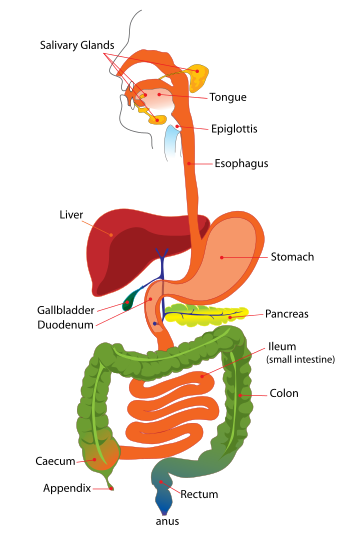
It can take about 24 hours for the food you eat to pass completely through your body. On the journey it is broken down: large, insoluble molecules are broken down into small, soluble ones that can be absorbed into the blood. This happens through 2 types of digestion:
MOUTH - Food is chewed here (to break it down and increase it's surface area). It is mixed with saliva which lubricates it and which contains the enzyme amylase. The breakdown of starch starts here. STOMACH - Food is churned and mixed with stomach juice. This contains the enzyme protease, which breaks down protein. The stomach juice also contains HCl which has 2 functions: to provide the acidic conditions favoured by protease, and to kill any bacteria or other nasties that you might have swallowed. SMALL INTESTINE - When the stomach contents is released into the small intestine, bile (produced in the liver but stored in the gall bladder) acts to neutralise the acid and emulsify the fats (thus increasing the surface area for lipase to act on). Protease, lipase (the enzyme that works on fats) and amylase are all released by the small intestine and pancreas in order to complete digestion. Finally the food is so broken down that it can be absorbed into the bloodstream. The small intestine has many folds (called villi) which increase its surface area, making absorption more efficient. LARGE INTESTINE - This is where water along with the undigested products of digestion end up. We are unable to digest cellulose, which makes the bulk of the faeces which is produced here. Since water is so precious it is absorbed. The rest of the waste is compacted and stored in the rectum before finally being expelled from the body through the anus. |
TOP TIP - REMEMBER THIS
Digestion starts in the mouth and carries on in the stomach, but most digestion takes place in the small intestine. Digestion is completed in the small intestine and this is where all absorption of nutrients takes place. The large intestine is the site of water absorption and faeces compaction Key terms:
Ingestion - the process of taking something into your body through your mouth (eating!) Peristalsis - the wave-like contractions that squeeze food around your digestive system Digestion - the breakdown of large insoluble molecules into smaller soluble ones Absorption - the process where small soluble products of digestion pass into the bloodstream in the small intestine Assimilation - using the soluble products of digestion to make new molecules needed by the body Egestion - the expulsion of faeces through the anus (having a poo!) |
More information on digestion is available here, along with a handy quiz
|
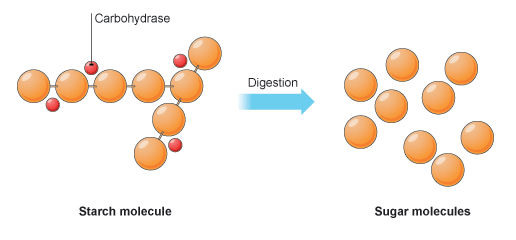
Amylase (a type of carbohydrase) catalyses the digestion of starch to maltose Amylase is produced in the mouth, pancreas and small intestine |
|
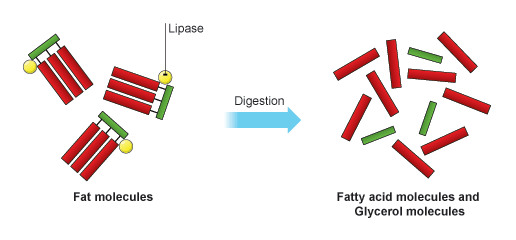
Lipase catalyses the digestion of lipid (fat) molecules to fatty acids and glycerol.
Lipase is produced in the pancreas and small intestine. Prior to the action of lipase, bile acts to emulsify the fat globules, breaking them up into tiny droplets. This increase the surface area for the lipase to act on |
|
|
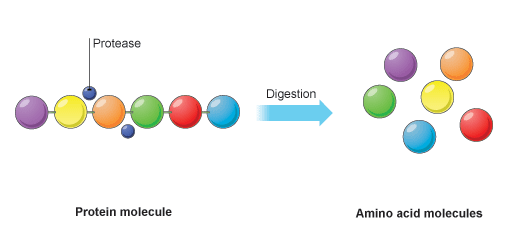
Protease catalyses the digestion of protein to amino acids Protease is produced in the stomach, pancreas and small intestine |
Remember:
Enzymes generally end in '-ase'
Enzymes generally end in '-ase'
|
Shape is everything!
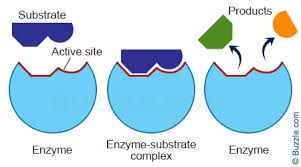
The shape of the enzyme is absolute critical for it's function. As you know, an enzyme is a protein. Proteins are made up of a simple chain of amino acids but they are folded and wrapped into very complex shapes. The ACTIVE SITE of the enzyme is the part that interacts with the substrate. The shape of the active site and the substrate exactly match, like a lock and a key. A substrate without the right shape will not fit into the active site |
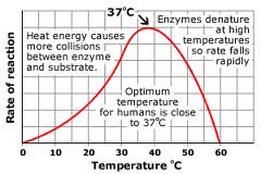
Enzymes, like all proteins, are sensitive creatures! They work best at a particular pH and a particular temperature - we say that this is their optimum pH/temperature. Each enzyme has its own preferences.
Most human enzymes work best at a temperature of 37 °C, body temperature. However, the choice of pH varies widely.
Most human enzymes work best at a temperature of 37 °C, body temperature. However, the choice of pH varies widely.
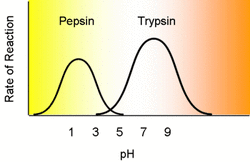
Proteases that digest protein in the stomach (e.g., pepsin) work best at low, acidic pHs (e.g., pH 2), but those that work in the small intestine (e.g., trypsin) have a preference for neutral or very slightly alkaline pH. Remember what bile does (see above)!
What's important to remember is this: The shape of the protein will only remain the same if the conditions are right. If the pH or temperature varies too much from the optimum for that enzyme, the shape of the enzyme will begin to change irreversibly. It's active site can then no longer fit with its substrate and we say the enzyme is DENATURED
Remember: most enzymes in the body work within cells. The digestive enzymes are produced in the cells but are then secreted into the gut where they come into contact with food - they are working outside of the cells!
What's important to remember is this: The shape of the protein will only remain the same if the conditions are right. If the pH or temperature varies too much from the optimum for that enzyme, the shape of the enzyme will begin to change irreversibly. It's active site can then no longer fit with its substrate and we say the enzyme is DENATURED
Remember: most enzymes in the body work within cells. The digestive enzymes are produced in the cells but are then secreted into the gut where they come into contact with food - they are working outside of the cells!
Still unsure? Why not have a look at BBC Bitesize for their great revision pages. There's a useful quiz at the end to check your understanding
making use of enzymes
|
Enzymes have a lot of industrial uses (see below). They are commonly used in biological washing powder, and in the production of baby food (proteases) and diet food products (isomerase). |
|
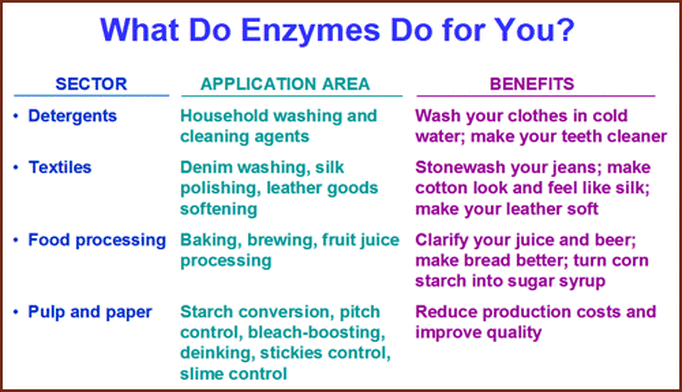
The use of enzymes in industrial processes has both advantages and disadvantages. You need to know both for your exams.
Advantages:
Enzymes catalyse reactions at relatively low temperatures and pressures leading to lower production costs
This also means they are considered more environmentally friendly
Enzymes in washing powder mean stains are removed at lower temperatures, also making them more environmentally friendly
Disadvantages:
Because enzymes are sensitive to temperature and pH, the processes needs to be very tightly controlled to prevent them denaturing. This costs money
If temperature or pH changes too much the enzymes will be denatured meaning a lot of money is needed to replace them
Enzymes are expensive to actually produce. Microbes are used to produce enzymes and they need to be supplied with food and oxygen
Enzymes in biological washing power can cause allergies
Advantages:
Enzymes catalyse reactions at relatively low temperatures and pressures leading to lower production costs
This also means they are considered more environmentally friendly
Enzymes in washing powder mean stains are removed at lower temperatures, also making them more environmentally friendly
Disadvantages:
Because enzymes are sensitive to temperature and pH, the processes needs to be very tightly controlled to prevent them denaturing. This costs money
If temperature or pH changes too much the enzymes will be denatured meaning a lot of money is needed to replace them
Enzymes are expensive to actually produce. Microbes are used to produce enzymes and they need to be supplied with food and oxygen
Enzymes in biological washing power can cause allergies
Enzymes in medicine
Used to detect disease (eg. testing for diabetes)
Used to cure disease (eg. lipase capsules are given to people otherwise unable to digest lipids)
Used to detect disease (eg. testing for diabetes)
Used to cure disease (eg. lipase capsules are given to people otherwise unable to digest lipids)
Check out this excellent website for more information on enzymes
